Abstract
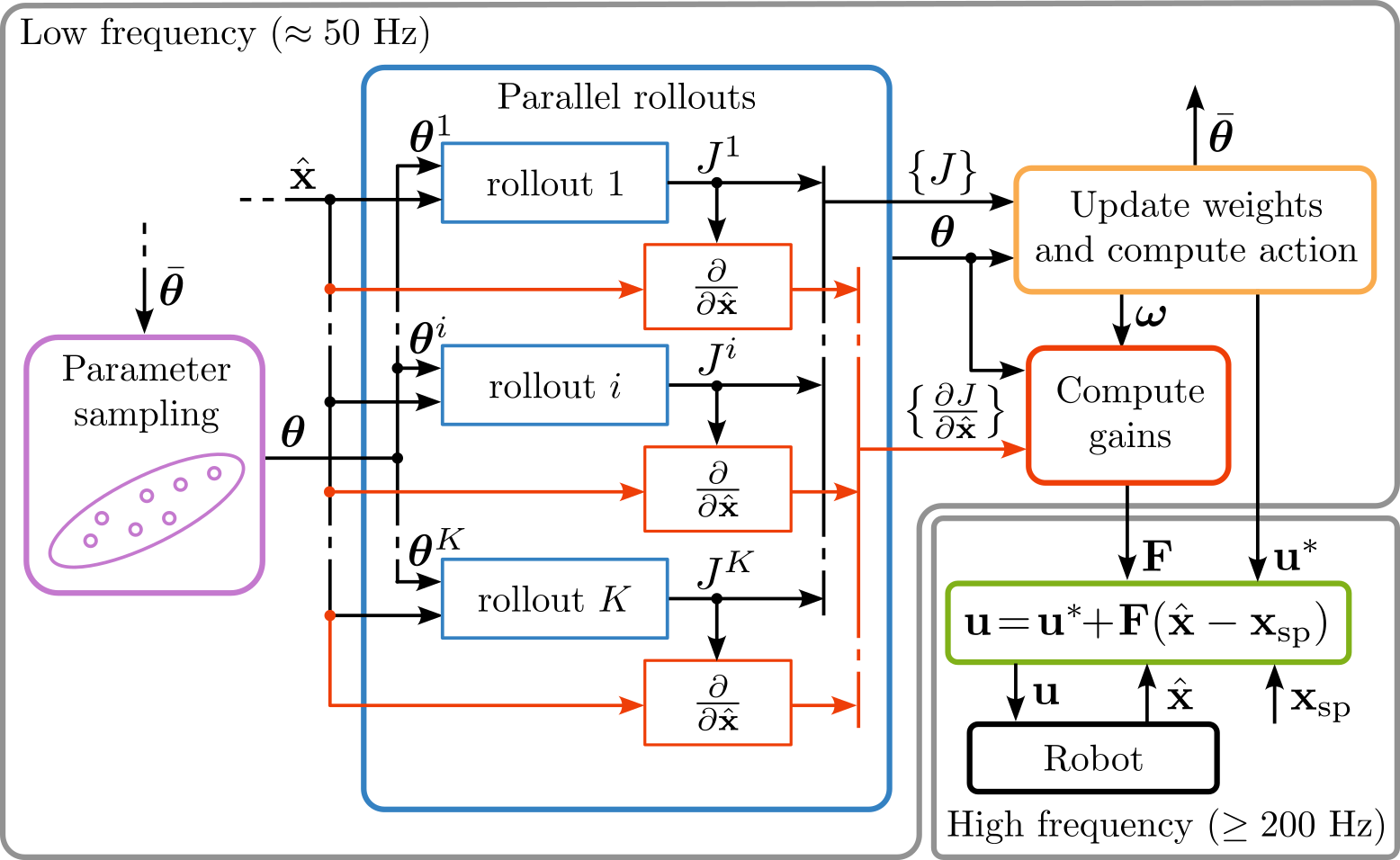
Model Predictive Path Integral control is a powerful sampling-based approach suitable for complex robotic tasks due to its flexibility in handling nonlinear dynamics and non-convex costs. However, its applicability in real-time, high-frequency robotic control scenarios is limited by computational demands. This paper introduces Feedback-MPPI (F-MPPI), a novel framework that augments standard MPPI by computing local linear feedback gains derived from sensitivity analysis inspired by Riccati-based feedback used in gradient-based MPC. These gains allow for rapid closed-loop corrections around the current state without requiring full re-optimization at each timestep. We demonstrate the effectiveness of F-MPPI through simulations and real-world experiments on two robotic platforms: a quadrupedal robot performing dynamic locomotion on uneven terrain and a quadrotor executing aggressive maneuvers with onboard computation. Results illustrate that incorporating local feedback significantly improves control performance and stability, enabling robust, high-frequency operation suitable for complex robotic systems.
BibTeX
@article{belvedere2026feedbackmppi,
      author={Belvedere, Tommaso and Ziegltrum, Michael and Turrisi, Giulio and Modugno, Valerio},
      title={Feedback-MPPI: Fast Sampling-Based MPC via Rollout Differentiation – Adios low-level controllers},
      journal={IEEE Robotics and Automation Letters},
      year={2026},
      volume={11},
      number={1},
      pages={1-8},
      keywords={Robots;Trajectory;Costs;Real-time systems;Quadrupedal robots;Optimal control;Computational modeling;Standards;Legged locomotion;System dynamics;Optimization and Optimal Control;Motion Control;Legged Robots;Model Predictive Control},
      doi={10.1109/LRA.2025.3630871}
    }